Cat Runes
From the Journal of Terrestrial Archaeology, issue 18/2310
The greatest riddle of modern history are the felines. This enigmatic furry race, which at one point had the entire planet in its paw, had mysteriously disappeared right before the Pandemoniac Doom of 2152 that wiped most of the intelligent life off the face of the Earth.
Though ubiquitous throughout the human art of those turbulent times, cats left only one scriptural heritage site, the Den, an underground sanctuary with feline writings.
There were only three short fragments.
The first one, preserved in a hidden compartment of a flat plastic casing, was scratched on a gilded fibrous material with faded floral patterns, allegedly used for covering walls inside pre-Doom human habitats. Note that while most characters are composed of short strokes and small circles, and only the last one stands out for its smooth shape. Some felinologists argue that this last character could mean an emphasis on the entire message, akin to an excalamation mark at the end of the sentence. Though we still don’t have enough material to interpret the secluded scipt, it remains beyond any question that this is an example of an ancient intelligent written speech of the Cats.
The next written fragment was carved into the wall of the cave, right above the plastic casing with first artifact. The writing in question is more erratic and consists of short scratched strokes, grouped by threes and fours. Most felinologists agree that this was an example of vulgar, lower speech, the one left, perhaps, by a servant, ordered to deliver the plastic casing to the cave.
The last writing, and perhaps, the most mysterious one, was obtained by pure accident. The explorers of the Den, having retrieved the first two artifacts and having thoroughly searched the walls of this magnificent cavern, decided to have a picnic. The way back to the surface was long and trying, and they figured it would do no harm to grab a bite. There were two of them, neither one having a remote understanding of feline culture (a felinologist would never do something of the like). The learned men sat down on the floor, unwrapped their cured ham sandwiches and opened a bottle of soda. Eventually, one of them knocked over the soda can, and the liquid spilled on the floor. It hissed and produced a suffocating odor, reacting with something on the ground. The two jumped up, and in the dim darkness of the Den saw the blue phosphorescent letters form in the puddle of hissing soda, the signs of the third message, radically different from the first two. They took photos of the miracle, and hurried out to get the felinologist, but alas! As soon as they were up on the surface, the ground gasped and sank down, burying the Den and the magical writings uncovered by chance.
As to the nature or the meaning of the last sigils, opinions vary. Some say, it was a ritual, magical protection of the Den to keep it from the intrusion of the humans and other uninitiated. Others claim it was a much more ancient writing made by another culture. There is also a third, informal opinion, that the whole story was made up by the two archaeologists in the pursuit of sensation. Whatever it may be, we are still yearning to decipher all three writings and glean some light on the wisest, oldest culture of Cats.
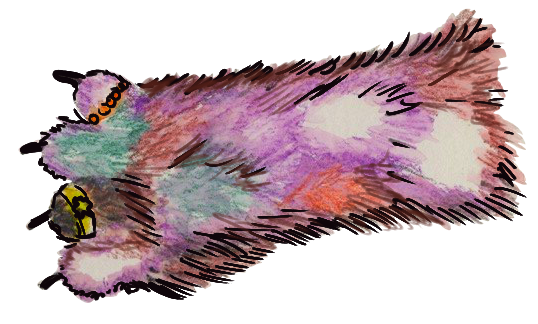
to scratch!